Healthy Aging at 30 vs. 50 vs. 70: 6 Things That Actually Change
Aging does not arrive all at once. It arrives in stages, and each stage has a different job. At 30, the change is invisible: you start losing 3% to 5% of your muscle mass per decade, and almost nobody notices. At 50, the change is felt: recovery takes longer, bone loss accelerates (women can lose up to 20% of bone density in the five years after menopause), and stiffness shows up in the morning. At 70, the change is functional: balance, power, and reaction speed become the things that decide whether you stay independent. The habits that matter barely change. What changes is the cost of skipping them.
Here is what actually shifts at each stage, what the numbers say, and the one thing worth prioritizing in each decade.
In this article
- What actually changes between 30, 50 and 70?
- What changes at 30?
- What changes at 50?
- What changes at 70?
- What does not change at any age?
- Which habit matters most in your decade?
- FAQ
What actually changes between 30, 50 and 70?
Six systems drive most of what people call "feeling older." They do not decline on the same schedule, which is why generic advice fails. Muscle starts slipping decades before you feel it. Balance holds steady for years and then matters enormously. Here is the side-by-side.
| What changes | At 30 | At 50 | At 70 |
|---|---|---|---|
| Muscle mass | Begins declining, 3% to 5% per decade. Invisible. | Noticeable strength drop. Loss can reach 8% per decade. | Fastest phase of loss. Directly affects daily function. |
| Recovery time | 24 to 48 hours after hard training. Forgiving. | Noticeably longer. Soreness lingers into day three. | Longest. Rest days become part of the plan, not a luxury. |
| Bone density | Peak or near peak. This is the bank account. | Sharp acceleration in women around menopause. | Steady decline. Fracture risk becomes the real concern. |
| Joint and tendon stiffness | Minimal. You can skip the warm-up and get away with it. | Morning stiffness appears. Warm-ups stop being optional. | Range of motion narrows. Daily movement keeps it open. |
| Aerobic capacity | Peak. Declines roughly 10% per decade from here if sedentary. | Clearly lower ceiling. Stairs and hills feel different. | Decline steepens. Trainability remains, at any age. |
| Balance and power | Not a concern. Reflexes cover mistakes. | Quietly declining. Worth testing, rarely tested. | The single highest-stakes system. 1 in 4 adults 65+ falls each year. |
Notice the pattern. At 30 the numbers are already moving but nothing hurts. By 70, the same numbers decide what you can lift, climb, and carry. The gap between those two points is not fate. It is roughly forty years of daily decisions.

What changes at 30?
At 30, the only meaningful change is one you cannot feel. Muscle loss begins. According to Harvard Health, after age 30 you begin losing as much as 3% to 5% of your muscle mass per decade, and most men lose about 30% of their muscle mass over a lifetime. Nothing about your 30s announces this. You still recover in a day. You can still take three months off and come back.
That forgiveness is exactly the trap. Your 30s are not a decade for damage control, they are a decade for deposits. Peak bone mass and peak muscle mass are the two accounts you will be drawing down for the next forty years, and how full they are at 35 shapes what 70 looks like more than anything you do at 68.
What to prioritize in your 30s
- Resistance training, twice a week, non-negotiable. Not cardio instead of it. Both, with lifting as the anchor.
- Protein at every meal. Cleveland Clinic suggests aiming for 20 to 35 grams per meal to support muscle maintenance.
- Load your bones while they will still respond. Weight-bearing work in your 30s builds a reserve you cannot build later.
- Build the habit, not the peak. A routine you keep for thirty years beats a program you abandon in eight weeks.
Creatine monohydrate is worth a mention here because it is the most studied supplement in sports nutrition, and the research base extends into older adults, including healthy aging benefits well beyond the gym. It is not a substitute for lifting. It is something people add alongside it.

Creatine monohydrate, L-theanine, and vitamins D3 plus K2 in one daily chew. Three gummies a day, in Strawberry Lemon, Mango or Watermelon.

What changes at 50?
At 50, the change becomes something you feel, and it arrives on three fronts at once. Recovery slows down, so the workout that used to cost you a day now costs two or three. Tendons and connective tissue stiffen, which is why mornings feel different and why skipping a warm-up now has consequences. And for women, bone loss accelerates sharply: Cleveland Clinic notes that women can lose up to 20% of their bone density within five years of starting menopause.
Muscle loss also picks up pace. Cleveland Clinic puts the rate as high as 8% per decade, with the process accelerating between 65 and 80. Combine slower recovery with faster loss and you get the classic 50s pattern: people train hard, get sore, back off, and lose ground during the backing-off. The fix is almost never "train harder." It is training consistently at a volume your recovery can actually absorb.
What to prioritize in your 50s
- Protect the training streak over the training peak. Two solid sessions a week for fifty weeks beats four sessions for twelve weeks and then nothing.
- Warm up properly, every time. Five to ten minutes of warming your muscles before you move makes the first working set feel like the third.
- Take recovery seriously as a scheduled input. Sleep, protein, and light movement on off days are the levers, not extra sets.
- Get a bone density baseline. Cleveland Clinic recommends all women have a bone density test by age 65, and earlier if you have risk factors. A baseline in your 50s is more useful than a first scan at 70.
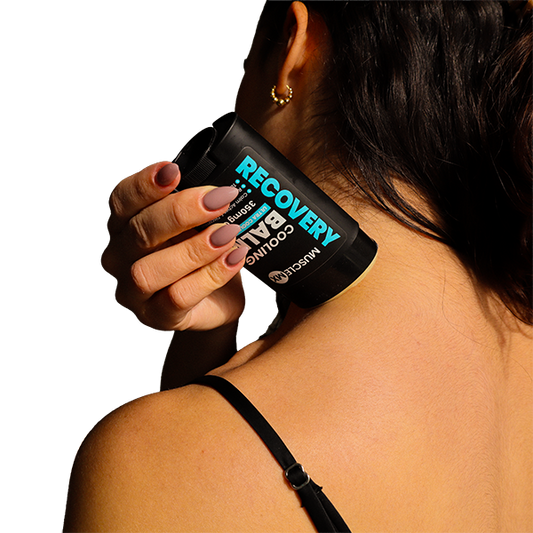
This is also the decade where a genuine full-day recovery routine starts paying for itself, because recovery has stopped being automatic.

A cooling CBD balm for overworked muscles and joints at the end of a long day. Available in 350mg standard and 1000mg extra strength.

What changes at 70?
At 70, the conversation shifts from performance to function, and the stakes go up. The CDC reports that 1 in 4 adults aged 65 and older reports falling each year, more than 14 million people, and about 37% of those who fall report an injury that required medical treatment or restricted their activity for at least a day. Harvard Health notes that people with sarcopenia, the clinical term for age-related muscle loss, face a 2.3 times greater risk of low-trauma fractures from falls.
That is why balance and power move to the top of the list at 70. Not strength in the abstract, but the ability to produce force quickly and catch yourself. Muscle mass and balance stop being fitness metrics and become independence metrics.
The encouraging part is that trainability does not expire. Harvard Health cites a meta-analysis of 49 studies in which men aged 50 to 83 doing progressive resistance training gained an average of 2.4 pounds of lean body mass. Starting at 70 works. It just works from a lower starting line, which is the argument for starting at 30.
What to prioritize in your 70s
- Balance training, daily and boring. Single-leg stands at the kitchen counter, heel-to-toe walking, sit-to-stands without hands. Two minutes, every day.
- Keep lifting, adjusted not abandoned. Machines, bands, and bodyweight all count. The stimulus matters more than the equipment.
- More protein, not less. Harvard recommends 1 to 1.3 grams of protein per kilogram of body weight daily for older adults doing resistance training, which is above the general adult guideline.
- Move through full range every day. A short morning stretch routine does more for daily function at 70 than any single workout.
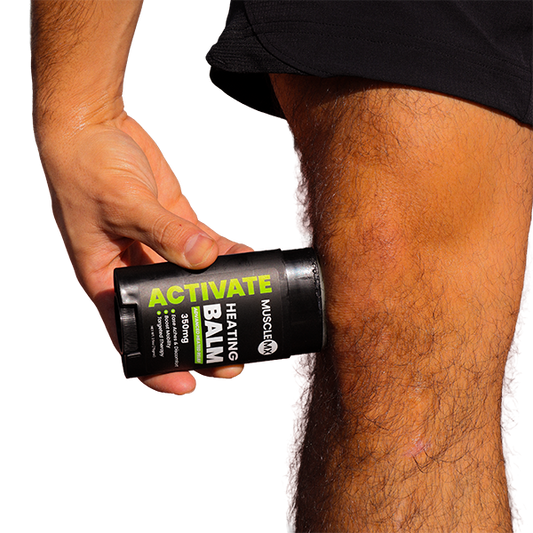
Warming tissue before movement matters more in this decade than in any other, because stiff tissue is both less comfortable and less willing to move through range.

A warming CBD balm for that nagging stiffness in your neck, back or knees. Built for mornings and pre-movement warm-ups.
What does not change at any age?
This is the part most decade-by-decade guides get wrong. They imply the playbook changes completely every ten years. It does not, and several of the most persistent myths about aging joints exist precisely because people assume it does. Four things are true at 30, 50 and 70:
- Resistance training is the primary lever. Nothing else touches muscle mass, bone density and functional strength at the same time.
- Protein intake matters, and the requirement goes up, not down. Older adults need more protein per kilogram than younger adults, not less.
- Muscle responds to training at every age. The 49-study meta-analysis above included men into their 80s.
- Consistency beats intensity. At every age, the plan you keep outperforms the plan you admire.
Skin is the quiet one on this list. It thins and loses moisture-holding capacity with age, which is why hands, knees and elbows get noticeably drier from the 50s onward. It is cosmetic until it is not: dry, cracked skin on hands and feet affects grip, comfort and how willing you are to move.

A 4-in-1 CBD lotion that hydrates and protects. Made for hands, knees and everywhere life takes a toll. From 300mg travel size.

Which habit matters most in your decade?
If you only change one thing, change the one your decade is most likely to neglect.
- In your 30s: start lifting, and do not stop. You are building the reserve. Nothing hurts yet, which is precisely why this is the decade people skip.
- In your 50s: fix your recovery, not your program. The training is rarely the problem. Sleep, protein and warm-ups are where the ground is being lost.
- In your 70s: train balance daily and keep the protein high. Two minutes of balance work has a better return on investment than any extra cardio.
One more reframe worth holding onto: the goal is not a longer life, it is a longer healthspan, the years you spend able to do what you want. Muscle, bone and balance are the three things that decide that number.
Frequently asked questions
At what age does the body start to decline?
Measurably, around 30. Muscle mass begins declining 3% to 5% per decade after age 30, and aerobic capacity starts falling at roughly 10% per decade in sedentary adults. Neither is noticeable at first. Most people first feel the change in their late 40s or 50s, when recovery slows and stiffness appears, which is 15 to 20 years after the decline actually started.
Is it too late to build muscle at 70?
No. A meta-analysis of 49 studies cited by Harvard Health found that men aged 50 to 83 doing progressive resistance training gained an average of 2.4 pounds of lean body mass. Muscle responds to training at every age tested, including into the 80s. The starting point is lower, but the response is real.
Why does recovery take so much longer after 50?
Several things stack. Muscle repair processes slow, connective tissue becomes stiffer and less elastic, and the deep sleep that supports tissue repair declines with age. The practical consequence is that the same workout costs more recovery days than it did at 30. The answer is usually lower training frequency at higher quality, plus more attention to sleep and protein, rather than pushing through.
How much protein do I need as I get older?
More than you did when you were younger. Harvard Health suggests 1 to 1.3 grams of protein per kilogram of body weight daily for older adults doing resistance training. For a 175-pound person, that is roughly 79 to 103 grams a day. Cleveland Clinic frames it per meal: aim for 20 to 35 grams each time you eat.
What is the single best exercise for healthy aging?
Resistance training, because it is the only category that improves muscle mass, bone density and functional strength at the same time. Two sessions a week covering the major muscle groups is the baseline in every decade. After 65, add two minutes of daily balance work, because falls are the leading cause of injury for adults 65 and older.
Do women and men age differently?
On bone, significantly. Women can lose up to 20% of bone density in the five years after menopause begins, which makes the 50s a distinctly higher-stakes decade for bone health in women than in men. Muscle loss follows a broadly similar pattern in both, though men typically start from a higher absolute muscle mass.
Recovery is the habit that makes the rest possible
Whatever decade you are in, the plan only works if you keep showing up. Warm up with Activate, wind down with Recovery.
Shop the Heating & Cooling Bundle →Two balms, $59 (regularly $69.98). Backed by our 30-day money-back guarantee.
This article is for general information and is not medical advice. Talk to your doctor before starting a new exercise or supplement program, particularly if you have existing bone, joint or cardiovascular conditions.